Wednesday, 21 April 2021

Wasted days and wasted nights

I have achieved virtually nothing today, other than making dinner.

I didn't read a page of any book, couldn't complete my cryptic crossword (one word to go), didn't get out for an afternoon walk (snowing and cold - it wasn't an excuse all through the winter so why is it now?) and didn't take a single photograph.

I did get out for a chilly power walk this morning, accompanied as always (and forever, it begins to seem) by the great Frederick Douglass. With Lincoln gone and the conservative - and racist - former VP Andrew Johnson in the White House, reconstruction in the south has been left largely in the hands of the states. (Johnson was an ardent states-righter.)  

Vengeful whites in the south are blocking progress of former slaves and viciously attacking them. Former Confederates have begun to make their way into Washington power circles. Douglass realizes there is still much work to be done to ensure that freedmen don't fall into poverty and despair. It's a political battle royal fought between conservative Republicans like Johnson, supported by Democrats, and progressive Republicans, for whom Douglass becomes an unofficial, but influential, spokesperson.

He sees his new mission is to prevent the dilution of the benefits of emancipation, and hits the speaking circuit with a punishing schedule through 1866. At one point, he and other black leaders force an audience with Johnson. Douglass and Johnson spar, but no minds are changed. Johnson is livid that Douglass and the other black leaders are insisting on full suffrage for blacks. After the meeting, he spews racist invective against Douglass, all of it recorded by his secretary and later reported.

*

I did work on a few more pictures from winter 2012, all taken near the river in Girona at dusk.


Tuesday, 20 April 2021

No, wait...winter's back

What an absurd climate! 

We seem to be going backward in time. It barely got above freezing today and snowed much of the afternoon. It was wet snow, and it didn't stay on the ground, but we're apparently going to get 5 cm of the stuff before it lets up, and possibly more tomorrow.

Then by Friday, it'll supposedly go back up to 15C with sun.

The war is over, the constitutional amendment abolishing slavery has passed. Much jubilation among abolitionists. Frederick Douglass is starting to think about what he might do now that the end he's fought for all his adult life has been won. There are still political issues to be fought - black suffrage and government assistance for freedmen chief among them - but he anticipates a diminishment of demand for his oratory. 

Douglass and another prominent black activist, Mrs. Dorsey, were given pride of place in the audience at Lincoln's second inauguration. And were invited to the reception at the White House afterwards. They were stopped by racist guards at the door but eventually let in. Lincoln marks Douglass out for special notice, begging him to give his opinion of the inaugural address. Douglass demurs at first but Lincoln insists. Douglass in fact thinks the speech a masterpiece of concision. In it, Lincoln made clear the war was about slavery and emancipation. He tells Lincoln he thinks it was "sacred."

And then a few months later, in April, John Wilkes Booth assassinates the president at the Ford Theater. The country and Douglass, who has come to see himself and Lincoln as more in agreement than he ever had imagined, are thrown into mourning and political confusion.

*

I did go out this afternoon, to Bulk Barrel for breakfast makings, it being seniors-discount Tuesday. And I did take the camera, but it was far too wet to take pictures. I had to stow it in my backpack.

I worked on a few more pictures from winter 2012. A lot of the raw files from that winter were corrupted at some point, probably in the course of transferring them from one hard drive to another - or so the oracle suggests. The pickings, as a result, are slimmer than usual, but I did find a few worth working on.

We're in Girona now. The river Onyar bisects the city. On the east side is the old town, built up a hillside, with a surviving medieval wall still running along its eastern and northern edges. On the other side is the modern city. 

Our flat was in the old town, on one of the many stepped streets climbing the hillside. The second picture is another of the hill streets. The river, with its pastel-painted apartment blocks, was only a few blocks the other way from the flat.


We took a couple of day trips out from Girona in a rental car. On the first, Shelley, Karen and I drove to France for lunch - the border is only about an hour north. 

We headed for the town of Collioure, which Karen and I remembered as a pretty little art colony where we'd spent a pleasant afternoon with Brian and Andrea eight years before when we were staying in a place just north. I'd taken a picture there that Shelley liked so much she had it framed in her apartment for many years. Shelley didn't think she knew the place at all. 

But when we drove into town, she immediately said it was a town she had visited with her family a few years before. Karen and I, confusingly, didn't recognize it at all. The confusion was eventually explained. 

The town has a rocky promontory that runs through the middle of it and out into the sea. Karen and I and the McCanns had spent most of our time on the north side, Shelley and family, on the south. We eventually found the places Karen and I remembered - which weren't at all familiar to Shelley. Weird.

Anyway, it's a pretty little town. It was a place a lot of famous artists came in the 1930s to get away from the fraught politics of the day - most prominently, Henri Matisse. The town has erected plaques at sites where famous paintings were made. It's still very much an art colony, with lots of studios and galleries. 

We explored the hilly streets with their pastel-painted houses, had a great lunch by the harbour - if expensive by the standards of Spain -  and drove in the afternoon to another arty French town, Ceret, before heading back to Girona.


The picture Shelley liked that I'd taken at Collioure in 2004.


Monday, 19 April 2021

Spring

It was a typical April day. We had sun and reasonably mild temperatures (16C) in the morning and early afternoon, then overcast and wind-whipped rain by 4:30. No afternoon walk today.

I did get out in the morning for my usual exercise. In my biography of Frederick Douglass, Lincoln has won the 1864 presidential election after all. On election night, a group of racist whites accosts Douglass on his way from the polling booth in Rochester. He stands up to and vanquishes them without having to strike a blow - this according to an eyewitness who was walking with him. 

The war is winding down, but much remains to be decided. The vote for freed blacks remains a critical issue for Douglass and other abolitionists, but there is considerable push-back, including from within the Republican Party. The orator is back on the road, often at Jubilee meetings across the north, exhorting blacks to be self-reliant and industrious. 

He also speaks in Baltimore that winter of 1864. Maryland, one of the slave-holding border states that stayed with the Union, votes narrowly to abolish slavery before the war ends. Douglass urges southern blacks to stay on the land, save up and buy land. But it very quickly becomes clear they will be frustrated. Whites won't sell land to blacks in the south, even land that sits unused.

It's all seems so depressingly familiar.

*

Nothing else much accomplished today - other than setting up a new printer, making our dinner and frittering away time trying to solve cryptic crosswords. The only thing remotely creative I did was work on some more of my winter 2012 photos.

I was working on them out of order yesterday. In today's batch, we're still in Valencia, at the end of Ralph's stay with us - so before we head to Girona. We're out in the evening more than Karen and I usually are, enjoying the pre-Fallas activities, including a big fireworks and light show display in City Hall Square. 

I don't know why I like this picture. It's really not very good, but it expresses to me the joy Spaniards seem to take in being together in a crowd. That night we were jammed into the square shoulder to shoulder, waiting for the fireworks to begin.


In our own neighbourhood of Ruzafa, a couple of the biggest fallas - both sponsored with big money from beer companies - are being constructed at street corners near us. We go out in the evening to check out the progress and enjoy the festival vibe.


This last was taken in the Basilica in the Square of the Virgin, while a church service was in progress.


Sunday, 18 April 2021

Spring in southern Ontario, it's so fickle. When I went out on an errand this morning, it was sunny and still. It felt wonderful. 

So when it was time for my run a little later, I dressed, I thought, accordingly: shorts, t-shirt, sweatshirt. It was freezing! The sun had gone in, a wind had sprung up. It was supposed to be 13C but felt at least five degrees colder. I was warm enough after five or ten minutes of exercise, but as soon as I slowed for my cool-down, the wind cut through me again.

It's 1864, and the cruel war is grinding toward its conclusion, though the outcome still remains uncertain. Plans, nevertheless, are already afoot in the north for post-bellum reconstruction of the south. Abolitionists rightly fear back-sliding on emancipation. Indeed, one proposal calls for freed slaves in Louisiana to be forced to stay on their current masters' estate and kept under slave-like discipline, albeit to work for a modest wage. 

Abolitionists, Douglass included, cry foul, accusing the Republicans of replacing slavery with serfdom. Lincoln is also balking at full suffrage for blacks that abolitionists are demanding, fearing it will turn away large racist elements among the Republican voter base. 

Another election is approaching. Lincoln is being challenged for the Republican nomination by a more radical anti-slavery candidate, and the Democrats are calling for a negotiated peace to end the war, playing on widespread war-weariness in the north as casualties mount. Douglass initially joins the anti-Lincoln critics, but then everything changes when the president invites him to the White House in April. 

In their meeting, Lincoln impresses and surprises Douglass with his commitment to full emancipation and his respect for Douglass. The president too, it turns out, is concerned about the fate of emancipation if the Democrats win and negotiate a peace. He proposes that Douglass help build a militarized underground railroad to spirit as many free slaves out of the south to Union lines and ultimately to the north before the election.

Douglass is in the process of planning how he will do this when news comes that Atlanta has fallen. It's the beginning of the end for the south. That's where I left off.

It's amazing how post-bellum southern romanticism - right up into our generation - has distorted the meaning of the fall of Atlanta and the other great military losses suffered by the Confederacy that ended the war. 

Those losses undercut the anti-war presidential campaign of the then pro-slavery Democrats, ensuring Lincoln would win. They also ensured the Confederacy would decisively lose, rather than be able to negotiate from a position of strength. The bottom line: it ensured millions of slaves would in fact be freed. 

But consider pop-culture representations of those events. They're always or often painted as tragedy - for the south. Think of Gone With The Wind in 1939. The fall of Atlanta no doubt was a tragedy - but the tragedy was that such destruction was ever necessary. Or think of one of the great anthems of the supposedly liberal 1960s, "The Night They Drove Old Dixie Down." A great song, but it expresses regret for the passing of an old-south culture that condoned enslaving black people. 

*

I did go out for a walk in the afternoon. A big loop through downtown and then to the Forks. I don't go far from home, and my photographic subjects don't vary much. Today's haul.

Alleyway between King and York streets

Downtown buildings reflected in mirrored glass of Lerner Law HQ


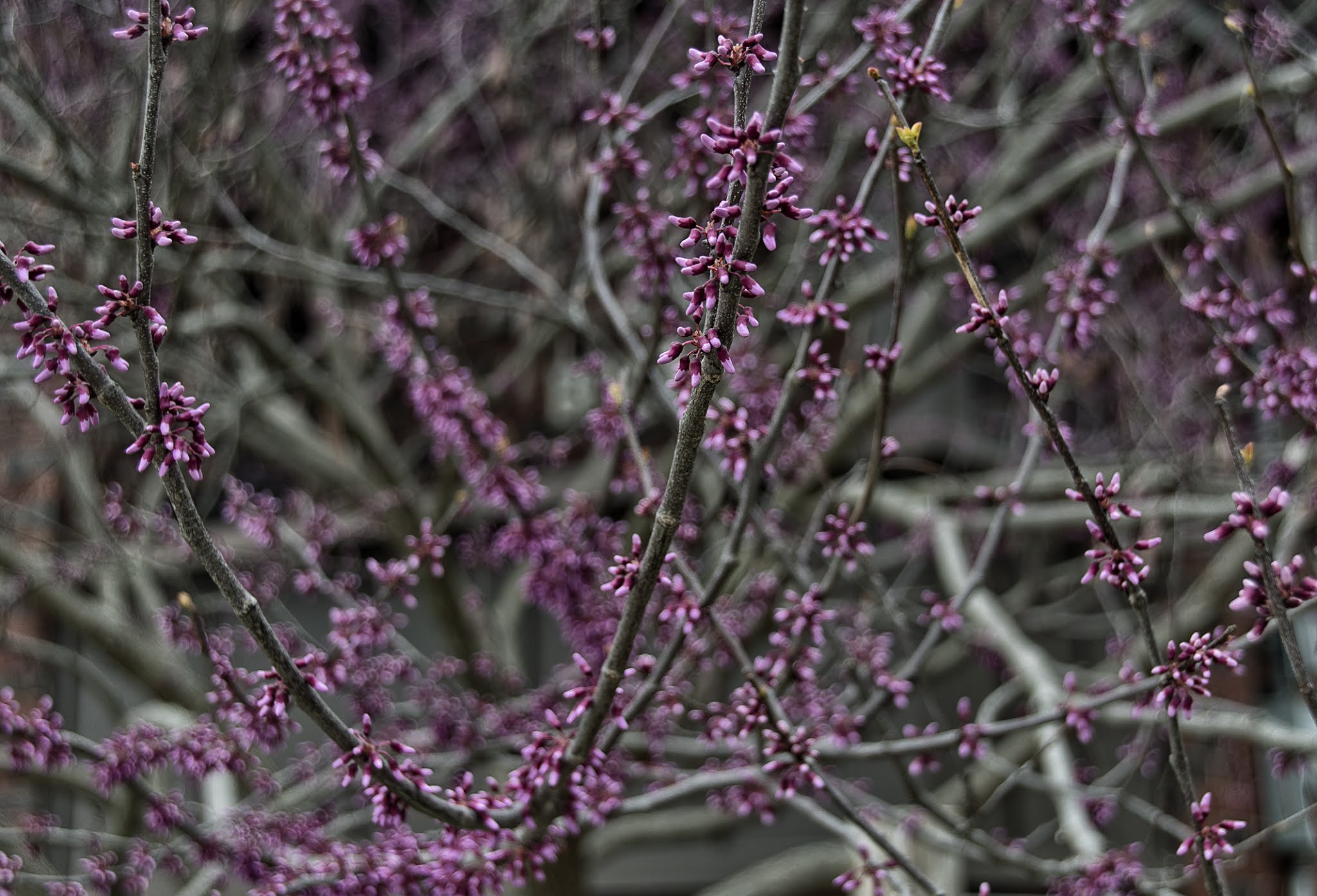
Fabulous blossoming trees at Forks of the Thames


At the Forks


Federal building off Queens Ave.

Provincial building off Talbot St.


Queens Ave. federal building - again


*

Plus, I'm still working on pictures from winter 2012. Here's one more from the Mardi Gras-like parade in Ruzafa that we watched when Ralph was with us in February. This guy looks pretty happy in his bright yellow sequined coat.

I'm not sure where these two were taken, possibly at the old convent in  Carmen, near the main square, which has since been renovated and turned into an art display space.


And this is one I snapped in City Hall Square as we were wandering home one early evening. The square is ringed with florist stands. I didn't notice the woman's goofy grin until after I got the picture up on my computer.


That year, the place we rented in Valencia, was already booked for one week in the middle - for the big week of Fallas. It was a regular booking from Amstel Brewery, which is a sponsor of the event. Among other things, it sponsors one of the biggest Fallas displays at a street corner about a block from where we were staying. 

So for that week, we arranged to meet Shelley in Girona, north of Barcelona. Shelly Rowe also joined us. One evening, when the ladies were at our shared flat imbibing and nattering, I ambled out on my own in the gloaming and chanced upon the church of Santa Susana. It's not on any list of top five attractions of Girona, but it's a gem of modern Catholic church decor.


Saturday, 17 April 2021

Seasonal

There is one good thing about the cooler, seasonable temperatures we've been having: it's helping slow the trees down so we can enjoy the blossoms longer. I was out again this afternoon, shooting blooms in various stages of bursting forth. Here's my haul.


I also couldn't resist one more go at the brutalist architecture downtown: louring weather meets louring buildings. This one is the downtown federal building (1980s) on Queens Ave. It's the architectural equivalent of a motorcycle cop in mirrored sunglasses. They're incompatible, my current visual preoccupations: blossoms and concrete bunkers. 


*

Got out for my exercise in the morning. Frederick Douglass and the rest of the U.S. are still mired in the the "cruel" war. Douglass has gone back out on the road, speaking all across the northern states, arguing that the war must be an "abolition war" and the peace to come, an "abolition peace," with blacks everywhere freed, and given equal rights.

His children have mostly come home to roost. Louis, the eldest, was wounded in the Massachusetts 54th's first action at Fort Logan in Charleston and has become seriously ill as a result. He is eventually honoroubly discharged. Charles the next eldest also sickened, and Douglass petitioned Lincoln to have him discharged as well. Rosetta, the Douglass's surviving daughter has given up teaching, come home to Rochester and married the family's gardener, an escaped slave. 

Only Frederick Jr., the youngest, remains in harm's way, working in the deep south recruiting freed slaves for the Union army.

Douglass considers enlisting himself but is talked out of it, especially by his English friends. Julia Crofts tells him his best weapons are his pen and his voice, not a sword.


Friday, 16 April 2021

Spring on hold II

A lazy day. I'm not going out for my afternoon ramble. It's just not very nice out: about 6C and windy, with solid cloud cover. We're used to better. The good new is, it's going back up to 12 tomorrow, with some sun.

I did get out for a run in the morning. We're still on the middle years of the Civil War in my audio book about Frederick Douglass. The focus is on race relations in the aftermath of the 1863 Emancipation Proclamation. It turns out the powers that be have lied to black enlistees. They do not get equal pay with white soldiers, and this rightly pisses them off. Some won't take any pay if it's not equal.

Douglass initially continues trying to convince blacks to enlist, but eventually ceases his recruitment work, citing the inequities. In the meantime, racist mobs in northern states are attacking blacks, especially abolitionists, and threatening lynchings. As Douglass says, it's as if the enemy were behind the lines.

The Massachusetts 54th deploys to South Carolina, where the Union army is besieging Charleston. In their first real action, they are assigned to lead the attack on an almost impregnable fortress. They actually break through and take one part of it, but  white troops don't support them and they're driven back with terrible loss of life. Louis Douglass survives. The regiment's white commander perishes.

Douglass goes to Washington to plead the case of  black soldiers. He seems to be received well. He even gets a meeting with Lincoln and comes away impressed, if not  satisfied. Lincoln basically says he can't authorize equal pay because it wouldn't play well with conservative elements he needs to keep onside.

Douglass is asked by government officials to travel to the south to recruit free and fugitive blacks, is given a letter of free passage and offered a commission in the army - something no other black man has been given. He goes home to Rochester and, in anticipation of the work he's taken on, closes down his newspaper after sixteen years. Then the commission doesn't materialize and Douglass refuses to serve without it.

It beggars imagination. Nothing changes. Recent data on pay inequities by race in the U.S. shows black men still make on average 1.3 cents less on the dollar than comparably qualified white men in the same job. In 1863, black privates were paid $10 a month, whites $13.

*

I continued working on my winter 2012 photos, including these two stitched-together panoramas of a couple of the best wall murals we saw in all our years in Valencia. They were on hoardings around a vacant building lot at a corner in Carmen, the nightclub district. (Note: as always you can click on the pictures to enlarge them.)


The next two were taken in Ruzafa, the neighbourhood where we were living. It was a parade that was part of a February multicultural festival. Ruzafa has - or had - a large number of immigrants, many from Latin America. They clearly were channeling the Mardi Gras tradition. 


*

I'm having an Irish moment in my "cultural" life. Karen and I are watching two Irish series on TV. One is the much praised Bloodlands, about politically motivated murder in Belfast. The other, which I think is even better, though less topical, is Blood, about a dysfunctional extended family in the west of Ireland. It stars Adrian Dunbar, who also plays the compromised head of the special investigations unit in the long-running Line of Duty .


And then I'm reading the debut novel by the latest hot young thing of the Irish literary scene, Naoise Dolan's Exciting Times. She has inevitably been compared to the other twenty-something rising star of Irish literature, Sally Rooney (Normal People, Conversations With Friends - both of which I've also read.) 

The two even look a little alike to my eye. Dolan is 29, Rooney 30. And while I'm sure both authors would protest the suggestion that their writing is similar, I think it in fact is, very. Both write in lucid, analytical prose about the relationships of twenty-somethings. 

Sally Rooney, Naoise Dolan


Exciting Times is a first-person narration of an affair conducted by a 22-year-old Dubliner of working-class background who goes to Hong Kong to teach English and takes up with a slightly older, upper-middle class English banker. Dolan tends to be a little more drily humorous than Rooney, perhaps. Rooney's writing arguably has a little more emotional depth. 

Thursday, 15 April 2021

Spring on hold

A stub today: it's way late. A game of Scrabble - I won - messed up my usual afternoon schedule.

The day was mostly gloomy and cool again. The high was in single digits. When I went out for my exercise this morning, it started sleeting almost immediately, but stopped pretty quickly.

I'm back on track with my audio book. Today it was all about the aftermath of the Emancipation Proclamation. The government authorized the use of black soldiers soon after it was passed on January 1, 1863. 

Douglass spent the first half of 1863 on a whirlwind tour, speaking to black audiences, exhorting the men to enlist. He was eventually hired as a recruiter for the first all-black regiment, the 54th Massachusetts. (It's the outfit featured in the 1989 movie Glory with a young Denzel Washington.)

Two of his sons, Louis, the eldest, and Charles were among the first to enlist. The blacks were promised equal pay and provisions, but weren't allowed to be commissioned as officers. Louis Douglass was a non-commissioned officer in the 54th. 

*

In the afternoon, I went for a walk around downtown. The sun briefly came out. My theme today was the works of nature and the works of man: new spring growth set off against iconic buildings.


*

I found time earlier in the day to begin working on my 2012 winter-away pictures. We had stayed in Valencia, Spain the year before, decided we liked the city a lot, but didn't care for the flat we'd rented. So before we left that spring, we found and booked another place, in a much better location, in the Ruzafa neighbourhood, near the the centre. That's where we came in the middle of January.

The pickings are a little slenderer than they were in 2016. I've been over this archive a few times before, searching for overlooked gems. But I did find a couple I thought worthy of more work. 

The first I shot at night from our Juliette balcony on Calle Cadiz, looking down Cadiz towards the centre. The second is at the City of Arts & Sciences: a streetscape of sorts, with a very modern-looking sculpture in the foreground, part of a temporary outdoor exhibit, one of the odd architectural features of the City and an ultramodern high-rise apartment block in the background. 

I can't decide if I like them better in colour or black and white.


Too hot!

I was starting to think The Plague Years  might be dead, but no, here I am again, after a four-day break.  Summer has arrived in southwester...